News & Updates

Progress reports and weekly course spotlights from the Reboot team — what each of our digital forensic training courses is, why it exists and who will benefit from it.

REBOOT UPDATE 1/26

Welcome to Reboot

Welcome to our first update following the launch of Reboot as a U.K. based digital forensic training company. Our intention is not to bombard you with sales pitches - more to inform you of our progress and our offerings. At this time, we are starting to see interest in all of our courses coming through our website, personal and corporate enquiries or through us reaching out to you as customers.

However, no company (training or otherwise) can operate without telling its existing and potential customers about what it is doing and what it is capable of. And we are no different! Why would we be?

Each week in our development, we will try to spotlight one of our 7 courses - what it is; why it exists; the core content of it; what the student will learn on it; & who will benefit from it. And then why you should come on it or send someone to attend it.

We’re doing that to promote our courses (of course we are) but also so that practitioners and managers can get a flavour of Reboot and why it exists. We’re new, we’re developing and we need to show that. We are current and former digital forensic investigators with a wealth of practical, hands-on, real-life experience dealing with the issues our clients now need to in terms of their digital evidence.

We didn’t learn a lot of this from a book or from someone else’s theory; we haven’t just done a year or so digital forensic work, done some training courses and now think we know it all and can teach it; or created a course because a customer needed to solve a problem. We have lived it, we have dealt with it and we have solved it hands on in a digital forensic workplace and been in a position where we have had to present that evidence!

We want to dig deep into the digital forensic world, we want to use our knowledge and experience to tell people how they can better perform their role and we want to help equip the digital forensic community (public and private sectors) to deal with the issues they face on a daily basis. And we believe we are the most experienced company to present that training with experienced and current practitioners working hand in hand – bringing you today’s issues in our training courses.

Will we change the world? We can try. Will we give you people in a classroom with a fabulous pedigree in this area? Yes - we will. And will we do it at a cost where in today’s financial climate it makes sense to use us? Yes – we will. And does that make us different? Yes – we think it does.

This week we will look at Repair Module 1.
REBOOT UPDATE 2/26

Course Spotlight: Repair Module 1

This week we look at our first mobile device repair course. We looked for a course name which dealt with repairing mobile devices - but we realised that no one name fits all repair issues. We realised that learning about mobile phones and other devices such as drones needed multiple skills and good, quality equipment. Some of these are base skills whereas others are much more involved and advanced.

So we decided to create a progressive programme of device repair starting from the skills most people need and moving to skills where perhaps less people need them, but are in a much more niche area.

The starting point is … Repair Module 1.

Our extensive experience in mobile device investigation says that today, there is a real need for devices to be on, working and accessible to the analyst so they can get to the data. This comes from the deployment of encryption over the last decade in smartphones and the limitations of our tools to deal with an unresponsive device. We’d love to defeat encryption, but we know that’s not an option for many people and there are tools for that - so long as the device is in that working state.

A working device has potential to be unlocked, accessed and the data extracted providing it can be:

  1. Powered,
  2. Interacted with through the screen, and
  3. Communicated with through the data port

Repair Module 1 dives right in there to address these issues.

In our digital forensic repair world, probably 80% of devices that don’t do one of the 3 things above can actually be solved by the analyst having some core knowledge and skills - and being able to record it, diagnose it, articulate it and then resolve it – and so get access to the data.

Some organisations we have dealt with in the past can’t let their staff ‘loose’ on a damaged exhibit device until they have had some basic training. Repair Module 1 (RM1) provides that skill set!

The module deals with power issues, screen problems and data port issues - the most common problems in allowing device interaction and extraction.

But it deals with many more things which will up-skill the analyst or investigator to think like a repair technician - but with a forensic hat on. And working to the standards we need to achieve.

So we provide Repair Module 1 - your entry point into device repair! Watch out next week for the next Reboot course!

REBOOT UPDATE 3/26

Course Spotlight: Repair Module 2

Last week we spotlighted Repair Module 1, and the core skills that digital forensic analysts need to get devices working and so accessible. This week we move to more advanced skills with Repair Module 2 (RM2). As an examiner or as a manager, the simple question has to be ‘Why do we need more skills?’.

The simple answer to that question is that devices and technology have developed considerably over the past decade (or maybe more) and to get at the data we need, we have to find different techniques when simple repair doesn’t work.

When we started looking at trying to extract data from devices, encryption was less of an issue. Today, encryption is everywhere and in all types of devices, from many of the more basic handsets to the latest smartphones. Finding a solution is key when the device doesn’t simply come on and we can go through the ‘front door’. And there isn’t normally a back door!

‘Chip off’ used to be a highly effective way of getting data that we could use, however encryption has frustrated that to a huge extent. There is still a place for those skills, and we will highlight and deal with that in Repair Module 3 (next week). But equally important these days is an ability to repair a device to get it working and where we may have issues which make the normal operation of the device impossible.

Examiners need to understand a device and the components that exist at PCB level. We will take them there and look at the way these components are used to create the electronic circuitry which makes the device work – or indeed stops it working when one or more becomes broken or defective.

So in Repair Module 2, we will teach basic electronics and circuitry. We will look at what happens when something becomes defective and needs replaced. Perhaps when a component causes internal power issues or a short circuit. We’ll get into more advanced micro-soldering and give delegates the skills to detect, diagnose and repair down at board level so the device can come back to life, the data can be accessed and then extracted.

We will take the delegates to a world of diagnosing IC (Integrated Circuit) problems and teach them all about device powering issues as well as many more advanced fault diagnoses.

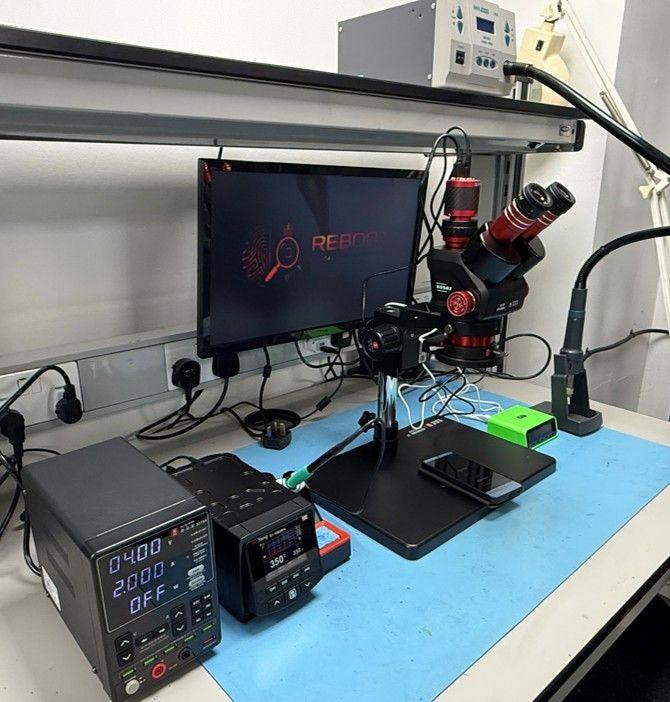
To do all of this, we need a quality repair workbench along with excellent repair training facilities. The Electronics Group training facility in Leeds provides us with that purpose-built teaching location which we at Reboot have enhanced - investing heavily in providing ultra-modern microscopes, soldering stations and hot air rework stations (amongst other things). Meanwhile our hugely experienced trainers, all with extensive digital forensic and repair training experience are able to deliver the quality courses other training providers can’t.

So we provide Repair Module 2 - your next step in device repair!

Watch out next week for the next Reboot course!

Reboot repair training workbench at the Leeds training facility, with stereo microscope, soldering station, bench power supply and hot air rework station
Each student will benefit from the latest repair and soldering equipment on their teaching lab workbench along with the highest quality teaching from highly respected and competent digital forensic practitioners and educators